


Key Highlights:
-
Growth follows consistent work. Building a consulting practice includes difficult months, but steady effort within a proven model provides structure for consistent progress.
-
Early structure helps new consultants get started. WSI’s onboarding and education give new members a clear starting point so they have a clear starting point for working with clients.
-
Proven methods help guide early decisions. Experienced professionals bring judgment, but tested approaches help them avoid the trial and error that often slows independent consultants.
-
Shared knowledge strengthens individual practices. Consultants across the network contribute ideas and experiences, so others can learn from what’s already been tested in real client work.
-
Structure protects independence. When core systems already exist, consultants are able to focus more of their work on clients, relationships, and strategic work.
Experienced executives and senior professionals often reach a point where consulting becomes a serious option. They understand strategy. They’ve guided decisions. They know how to advise clients.
What’s less familiar is running a consulting business.
Independent consultants often spend months building sales routines, shaping their offerings, and learning how to attract the right clients, often through trial and error. Pricing, proposals, and client conversations don’t always come naturally, even for experienced leaders.
That work takes time. Energy that could go toward client work ends up going into building the business itself.
That’s where WSI’s structured consulting platform comes in. Rather than building every element from scratch, experienced professionals start with shared expertise, established frameworks, and a global network of consultants working in digital strategy and AI.
The work of building a business remains, but it starts with more clarity and direction.
That’s what stood out to Domenic Ali when he first explored WSI.
From Corporate Leadership to Advisory Ownership
Before joining WSI, Domenic spent years working with clients inside large technology organizations. Much of his work involved helping companies evaluate solutions, align internal teams, and make major purchasing decisions.
Those experiences developed the skills that later carried into consulting. He learned how organizations make decisions, how leaders weigh competing priorities, and how to guide conversations that shape business direction.
What he did not yet have was a clear path for running his own consulting business.
As he explored that next step, Domenic looked at several franchise opportunities before discovering WSI. What stood out was the straightforward message: the network would provide education, shared experience, and proven ways of working, while the responsibility for building the business remained his.
This combination appealed to him. The structure was there, but he remained in control of how he built his business.
Early Experiences Inside the Network
As he evaluated the opportunity, Domenic took time to understand how the model worked. He spoke with several consultants, asking direct questions about the work and the realities of running a consulting business.
One thing became clear during those conversations. Consultants across the network were willing to share their experiences with someone still exploring the opportunity.
After joining, Domenic completed the early learning and onboarding activities and spent a week working closely with a small group of new consultants. Many of those relationships continued after the program ended.
The group stayed in touch during the first year, meeting regularly to compare notes and talk through the challenges that come with starting a consulting business.
Through those conversations and the guidance available across the network, Domenic gradually built confidence in running his practice.
In this feature from WSI’s 30th Anniversary collection, Domenic shares his experience of building a consulting business within a community where members actively exchange what they learn in practice.

When Experience Meets Proven Process
Domenic arrived with years of leadership experience and strong instincts about how to approach clients and grow a business.
At times, those instincts led him to try methods that differed from what the WSI network recommended.
Looking back, he describes the moment with some humor:
“They’re teaching me a bunch of things and saying, do it like this. I’m thinking, I could do it better. It took me about a year to realize—why didn’t I just listen the first time?”
The experience reinforced an important point for him. Judgment matters in consulting, but proven methods exist for a reason.
Across the WSI network, many consultants have already tested different approaches to building and running their practices. Learning from that shared experience helped Domenic move forward with more clarity as he built his business.
For experienced professionals, the challenge is rarely knowledge. Most have spent years guiding decisions, solving problems, and advising leaders. The real challenge is turning that experience into a business that works.
This is where a proven model makes a difference. When the systems, training, and shared experience already exist, consultants can focus more of their time on client advisory work.
Collective Expertise as an Advantage
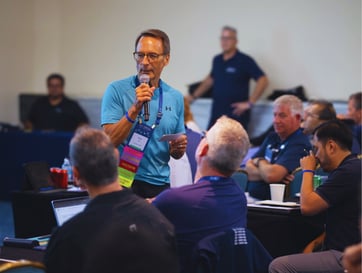
When Domenic talks about the WSI network, he often points to how openly consultants share what they are learning from their work with clients.
Across the community, consultants regularly exchange ideas about what is working, what is changing, and what they are seeing in their markets. The home office gathers those insights and turns them into updated training and practical guidance.
Domenic sometimes describes the pace of learning as a “firehose.” New perspectives appear constantly as consultants compare notes from real client situations.
Shared learning also plays a central role in how WSI continues to evolve its approach to digital strategy and AI. Instead of each consultant researching every tool independently, the network actively tests, refines, and shares what works. Insights spread quickly, turning individual discoveries into shared capabilities.
For Domenic, that collaborative approach means he can spend more time advising clients while the network continues to build and refine its expertise.
Structure Enables Independent Growth
Building a consulting business includes difficult periods, especially in the early months.
Domenic speaks openly about those challenges. Progress can be slow at first, credibility takes time to build, and persistence becomes part of the work.
As he describes his experience:
“It is a wild journey. There are a lot of ups and downs. But what I’ve noticed is that, over time, you begin to see progress as long as you’re doing the work and you stay committed.”
For him, that progress came from more than determination. The structure around the business played a key role.
Since Domenic joined, WSI’s training and onboarding have continued to evolve. New consultants now gain clarity and confidence in how to approach their work earlier in the process than when he started.
That shared knowledge helps new consultants build confidence and clarity earlier in the process.
For experienced professionals, the goal is not simply to start a business. It is to build one that improves with each client and each decision.
A proven consulting platform built on shared frameworks, global expertise, and real client applications can help support that process.
What Experienced Leaders Often Discover
Domenic’s advice to new consultants is simple: learn as much as you can from the network and put it into practice quickly.
Many of the approaches taught inside WSI come from years of experience across the community. Trying to recreate them on your own often slows things down.
He also points to something else that makes the network unusual. Each month, he makes a point of speaking with someone new in the WSI community.
In practice, those conversations are easy to arrange. Even consultants running established practices are willing to spend time sharing what they have learned.
A willingness to help one another is part of how the network operates.
For professionals thinking about building a consulting practice, the takeaway is clear. Experience still matters most, but working within a model built on shared experience can help bring structure to how the business is built.
When Experience Meets the Right Model
Domenic Ali built his consulting business step by step. Like most business owners, he faced uncertainty along the way.
What helped was the structure around the work. The network provides structure and shared expertise, while consultants lead client strategy and business development independently.
For experienced professionals thinking about ownership, that support can make a real difference.
If you’re exploring how to build a consulting business around your experience, start with a conversation to understand what’s involved and whether the WSI model fits your goals.