


Key Highlights:
-
Consulting is starting earlier in the decision process. Consultants can become involved before a campaign, platform, vendor, or AI tool has been selected, helping clients define the business issue before choosing a solution.
-
The starting point changes the engagement. Solution-led work begins with a defined request. Strategy-first advisory begins by examining the business issue, establishing priorities, and determining which work should follow.
-
Advisors help shape what happens before execution. They identify the real issue, uncover dependencies, set priorities, and determine what needs to happen first.
-
Executive experience fits this work well. Years spent aligning teams, evaluating investments, managing change, and making trade-offs become directly relevant.
-
Advisors don’t work in isolation. WSI supports their judgment with its Business Strategy Framework, AI Adoption Roadmap, specialist expertise, and global network.
A leadership team can have a clear ambition for the business and still struggle to decide which initiatives deserve attention first.
Improving customer experience may involve sales, operations, data, and technology. Introducing AI may require changes to workflows, responsibilities, and how information moves between teams. What begins as a technology request can quickly become a broader business decision.
Choosing the right tool is only part of the challenge. Leaders also need to understand the problem they're solving, which decisions depend on others, and what the organization is ready to implement.
Digital and AI consulting is increasingly involved at this earlier stage, helping organizations establish direction before committing to a solution.
For experienced professionals, the work draws on familiar capabilities: evaluating options, challenging assumptions, aligning stakeholders, and guiding decisions when the answer isn't obvious.
Digital and AI Decisions Are Moving Upstream
A technology decision rarely stays within the department that first raises it.
A manufacturer considering AI for customer service may need to examine how product knowledge is maintained, where customer information sits, and which teams are responsible for keeping that information accurate.
A professional services firm exploring automation may discover that its larger challenge is inconsistent processes across offices. A distributor evaluating a new customer platform may need to address how sales, service, and operations share information.
In each case, the initial request concerns technology, but the underlying decisions involve business processes, accountability, and organizational priorities.
The consultant's role begins with understanding those connections, rather than assuming the requested technology is the right starting point.
Recent AI adoption research reinforces the need to examine how technology changes business operations. McKinsey’s 2026 State of AI survey found that 56% of respondents said their organizations use AI in three or more business functions, up from 51% a year earlier. Yet only 37% reported that AI had affected their organizations’ operating profit, essentially unchanged from the previous year.
McKinsey’s AI high performers were also much more likely to report redesigning workflows because of AI: nearly three-quarters, compared with roughly one-quarter of other respondents.
Microsoft’s 2025 Work Trend Index found that 82% of leaders viewed 2025 as a pivotal year to rethink key aspects of strategy and operations.
Decisions about data, workflows, and budgets often need leadership involvement because they affect how teams operate across the business. That means the consulting conversation often needs to begin before a platform, campaign, or AI solution is chosen.
That strategy-first approach is central to how WSI consultants work: beginning with the business issue, then drawing on frameworks and specialist expertise to determine what should happen next.
The Important Question Comes Before “Which Tool?”
Some consulting engagements begin with a solution already in mind. The client has identified what it wants and is looking for someone to deliver it.
A strategy-first advisor enters earlier, while the business is still examining the problem, weighing options, and deciding what should happen next.
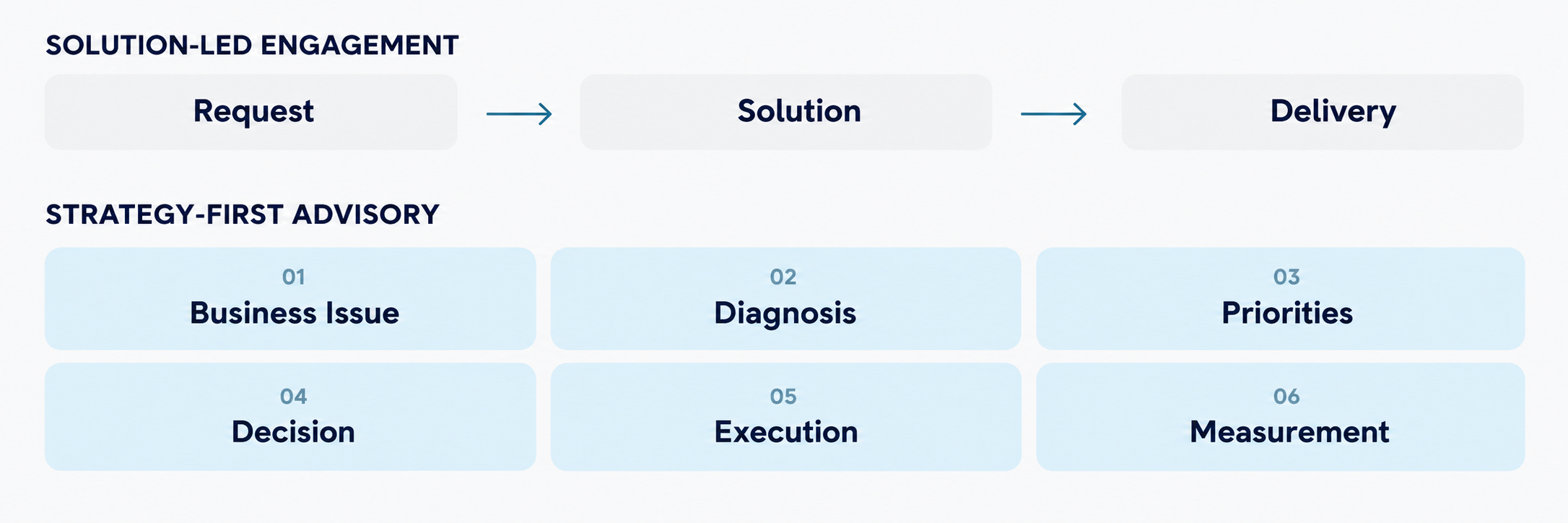
An upstream advisor enters before the solution has been chosen.
A client may say, “We need a chatbot.” In a delivery-led engagement, that usually leads straight to scoping and implementation. An advisor would first ask why the chatbot is needed and what business issue it is meant to solve.
That may lead to more practical questions. Is the issue important enough to address now? Is the data ready? Who owns the process? Which teams will need to change how they work? Is AI even the right answer?
The answers may point to a different first step.
Some initiatives may be ready to move forward. Others may need more preparation, a different approach, or no further action at all.
Execution still matters, but it starts from a clearer decision about what the business is trying to achieve and why.
What Does an Upstream Digital and AI Advisor Actually Do?
An upstream advisor helps leadership determine whether the organization is solving the right problem before recommending a solution.
That distinction changes the engagement. The initial request becomes something to examine, not automatically a brief to fulfill. The advisor considers what is driving the request, which assumptions need testing, who will be affected, and whether the organization is prepared to act on the recommendation.
Sometimes the answer is to change course. An initiative may need more preparation, a different approach, or a stronger business case before the company invests further.
Once the priorities are clear, the advisor helps leadership decide what should happen next, who needs to be involved, and where deeper expertise is needed.
That role doesn’t end when implementation starts. The advisor continues to keep the work focused on the business goal and helps leadership assess progress against the objectives established at the outset.
Specialists handle the deeper execution. The advisor makes sure the work starts from a sound decision and continues to serve the purpose leadership agreed on.
What Upstream Advisory Looks Like in Practice
Take a mid-market manufacturer whose leadership team believes an AI chatbot could improve how customer inquiries are handled.
A typical service engagement might begin by defining what the chatbot needs to do and preparing for implementation. An upstream advisor would first ask why customers are having trouble getting answers.
The issue may have little to do with the chatbot itself. Important product and service knowledge may sit with a handful of long-tenured employees, customer records may be spread across regional CRM systems, and the business may lack clear ownership of customer data.
Introducing a chatbot at that point could carry those same problems into a new tool.
Leadership may need to address those issues first by documenting key service knowledge, improving customer records, and clarifying who owns the information AI will rely on. AI may still be part of the solution, but a different application or sequence may make more sense.
Specialists can handle the CRM, knowledge-management, and AI work as needed. The advisor helps leadership decide what should happen first and keeps each step focused on the business goal.
Why Executive Experience Matters in Upstream Advisory
Upstream advisory depends on understanding how decisions are made across a business, especially when several teams, budgets, and priorities are involved.
In the manufacturer example, the harder decisions may have little to do with the chatbot itself.
Leadership may see a chatbot as the answer to a service problem, while the real issue sits in how knowledge is stored, how customer information is managed, or how teams work together. A regional sales leader may need to share data they have historically controlled. A CFO may need a clear reason to fund less visible groundwork before approving the technology originally requested.
Experienced leaders have dealt with these kinds of decisions throughout their careers. They know how to question an initial request, weigh competing priorities, bring different stakeholders into the same conversation, and determine whether a proposed initiative makes sense for the business.
That experience also helps when technology changes the way people work. Even a strong solution can struggle if teams do not understand the reason for the change or what is expected of them.
Experienced professionals don’t need to become specialists in every new platform. Their experience is useful because they understand how decisions move through an organization and can help leadership choose a practical way forward.
Why an Advisor Needs More Than Personal Expertise
Working at this level also means knowing when to bring in other expertise.
An advisor may understand the business problem clearly, but the solution can involve areas such as CRM, customer experience, data, AI, or development. No one person is expected to handle all of that alone.
The advisor needs enough knowledge to ask good questions, understand the recommendations, and know when specialist support is needed.
The advisor leads the client relationship and helps guide the key decisions. WSI’s frameworks give consultants a consistent way to approach those conversations, while specialist expertise across the network supports the work when needed.
Experienced professionals can stay focused on advising the client and bring in additional expertise when the work requires it.
A Consulting Platform for Leaders Who Want to Work Upstream
WSI gives experienced professionals a way to apply this kind of advisory work within an established consulting network.
Since 1995, WSI has helped businesses adapt to major changes in digital technology. As digital and AI decisions have become more closely tied to business strategy, the role of the consultant has expanded with them.
WSI brings together a global network of consultants who help organizations connect business strategy with digital transformation and AI adoption.
Its consulting approach begins with the client's business priorities. The Business Strategy Framework and AI Adoption Roadmap help consultants structure those conversations, while specialist expertise across the network supports implementation when needed.
For former executives, consultants, and business leaders, the model provides a way to apply years of business judgment directly to client advisory work.
Is Upstream Advisory the Right Next Chapter for Your Experience?
For experienced professionals, the question is whether this kind of work feels familiar.
If you are used to looking beyond the initial request, connecting technology decisions to business priorities, working through disagreement, and making trade-offs before money is committed, much of that experience already applies.
The same is true if you prefer helping leaders decide what should happen next rather than managing every part of delivery yourself.
As digital and AI decisions become more important to the business, clients need advisors who can help them choose where to focus before another project or technology investment begins.
For experienced leaders considering their next move, WSI provides a consulting platform that puts business judgment and leadership experience at the center, supported by proven frameworks, specialist expertise, and a global network.
If you're considering how to apply your leadership experience in an advisory role, explore how WSI's strategy-first consulting model works, what support is available, and whether it's the right fit for your next chapter. Start a conversation with the WSI team.